Συνέδρια, Ημερίδες, Ομιλίες, Διαλέξεις Διακεκριμένων Ομιλητών

id: 
8

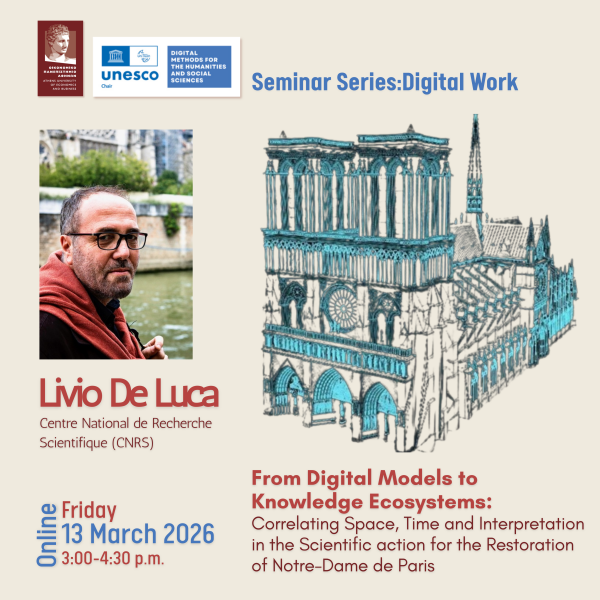
UNESCO Chair Lecture: From Digital Models to Knowledge Ecosystems: Correlating Space, Time and Interpretation in the Scientific action for the Restoration of Notre-Dame de Paris, by Livio De Luca


UNESCO Chair on Digital Methods for the Humanities and Social Sciences

Seminar Series: Digital Work


Time

Friday, 13 March 2026, 16:00-17:30, Athens time (15:00-16:30 CET)

Place

Online: https://www.dept.aueb.gr/en/unesco/live

Speaker

Livio De Luca

Centre National de Recherche Scientifique (CNRS)

Title

From Digital Models to Knowledge Ecosystems: Correlating Space, Time and Interpretation in the Scientific action for the Restoration of Notre-Dame de Paris

Abstract

Heritage research transforms the interaction between material objects and multidisciplinary inquiry into a powerful engine of collective knowledge production. Drawing on the scientific programme of Notre-Dame de Paris, this talk presents an innovative approach to computational modelling and digitisation that moves beyond the mere reproduction of physical form toward the structured exploration of knowledge itself. Mobilising specialists from archaeology, anthropology, architecture, history, chemistry, physics and computer science, the Notre-Dame scientific action has generated a large corpus of heterogeneous data reflecting contemporary scientific practices in heritage research. Our ambition is to correlate and structure this multidimensional information along four fundamental axes: space, form, time and knowledge domains. These axes are explored through geometrico-visual representation, semantic annotation, temporal tracking of transformations, and the analysis of thematic and disciplinary intersections.

Methodologically, this approach seeks to document and formalise the scientific gestures that underpin research processes, making explicit how data are produced, interpreted and interconnected. Technologically, it relies on the development of an innovative socio-technical ecosystem (including collaborative tools for acquisition, categorisation and annotation) and on the design of autonomous correlation engines capable of dynamically interrelating diverse datasets and perspectives. Through experimental software such as Quasi.modo and Dür.air, digital models become evolving research environments: not merely representations of heritage objects, but structured spaces in which material evidence and interpretative frameworks mutually inform and transform one another.

Screenshot 2025-09-10 at 16.59.26.png


Livio De Luca

Livio De Luca is a Research Director at the CNRS and an architect by training, with a PhD in engineering and an Habilitation in computer science. He led the CNRS/Ministry of Culture MAP Laboratory (Models and Simulations for Architecture and Heritage) from 2012 to 2023 and has coordinated numerous national and European research projects. His work focuses on 3D survey and geometric modelling, semantic enrichment of digital representations, multidimensional information systems, and knowledge graphs for cultural heritage.

Since 2019, he has coordinated the “Digital Data” working group within the CNRS and Ministry of Culture scientific programme for the restoration of Notre-Dame de Paris. Since 2022, he has been the recipient of an ERC Advanced Grant. He serves as Editor of the Journal of Cultural Heritage (Elsevier) and Associate Editor of the Journal on Computing and Cultural Heritage (ACM) and Digital Applications in Archaeology and Cultural Heritage (Elsevier). His work has received several distinctions, including the Pierre Bézier Award (2007), the Research and Technology Medal of the Académie d’Architecture (2016), the CNRS Innovation Medal (2019), and the UID (Italian Union for Design) “Targa d’Oro” (2021).

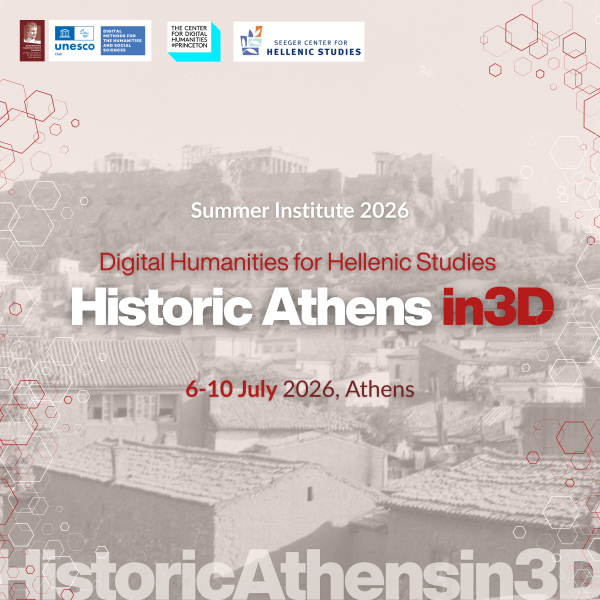
Summer Institute 2026: Digital Humanities for Hellenic Studies – Historic Athens in 3D, 6-10 July, Athens

UNESCO Chair on Digital Methods for the Humanities and Social Sciences


Summer Institute 2026
Digital Humanities for Hellenic Studies – Historic Athens in 3D, 6-10 July 2026, Athens


This workshop is designed for scholars interested in exploring digital humanities methods for representing archival information and rich narratives about historical urban spaces. Participants will be introduced to key topics, approaches, and tools, such as working with spatial data, 3D modeling, photogrammetry, data annotation, AI tools, and telling stories with data. Workshop participants will work collaboratively to create 3D, information-enriched visualizations of the early 20th-century Vrysaki neighborhood of Athens before its demolition. This work will draw on a unique collection of historic photographs and maps from the 1930s, created by photographer M. Messinesi and held in Princeton’s Art and Archaeology Department’s Visual Resources Collection.

The workshop is open to scholars from all disciplines, regardless of technical background. Experience with spatial data, 3D modeling, or other digital tools and concepts is welcome but not required. This workshop will be of particular interest to those in Hellenic Studies, History, Art and Archaeology, Urban Studies, Architecture, Cultural Studies, Public Humanities, and Photography. Knowledge of Greek is not necessary.

This program is sponsored by the Seeger Center for Hellenic Studies at Princeton University in collaboration with the Center for Digital Humanities at Princeton; the Princeton University Library, the UNESCO Chair on Digital Methods for the Humanities and Social Sciences, Athens University of Economics and Business (AUEB); the MSc Program in Digital Methods for the Humanities at AUEB; and the Digital Research Infrastructure for the Arts and Humanities (DARIAH-EU).

Language: English

Application deadline: 15 March 2026

More information and applications: https://hellenic.princeton.edu/opportunities/summer-institute-digital-humanities-hellenic-studies-%E2%80%93-historic-athens-3d

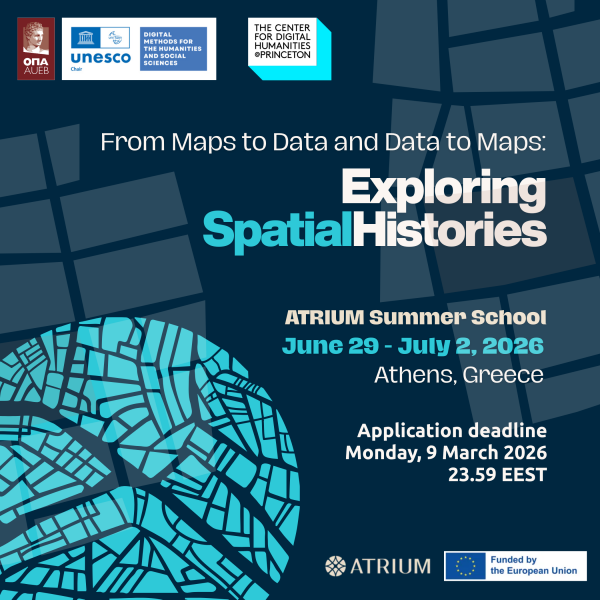
From Maps to Data and Data to Maps: Exploring Spatial Histories, ATRIUM Summer School, June 29 – July 2, 2026 – Athens, Greece

From Maps to Data and Data to Maps: Exploring Spatial Histories

ATRIUM Summer School | June 29 – July 2, 2026 | Athens, Greece


The ATRIUM Summer School, From Maps to Data and Data to Maps: Exploring Spatial Histories, invites applications from scholars and professionals interested in digital humanities methods for mapping and spatial visualization. Taking place in Athens, Greece, from June 29 to July 2, 2026, the program offers an intensive introduction to spatial data, cartography, and collaborative digital scholarship.

Organized by the UNESCO Chair on Digital Methods for the Humanities and Social Sciences at the Athens University of Economics and Business as part of the Horizon Europe project ATRIUM, in cooperation with the Center for Digital Humanities at Princeton University and the Athena Research Centre, this summer school brings together leading experts in digital humanities. Instructors will include members of the UNESCO Chair at AUEB, the Center for Digital Humanities at Princeton, the Princeton University Library, and the Digital Research Infrastructure for the Arts and Humanities (DARIAH-EU).

Participants will explore key topics such as spatial data collection, geocoding, georeferencing, map annotation, data wrangling, and digital mapping platforms. Through hands-on workshops and collaborative projects, attendees will create a digital map of the historic Vrysaki neighborhood of Athens, demolished in the 1930s for expanding the excavation of the Ancient Agora, using rare photographs and maps. They will also work with Rigas Velestinlis’ Charta of Greece, transforming a richly detailed eighteenth-century map into structured, interoperable spatial data using the ATRIUM Collaborative Map Annotation Workflow.

The program combines lectures, discussions, site visits, and practical instruction to introduce participants to the opportunities and challenges of spatial humanities. No prior technical experience is required. It is open to graduate students, postdoctoral fellows, researchers, and professionals across the humanities. Participation is tuition-free, and funding support may be available for non-Athens residents. 

Read the full Call for Applications: https://www.dept.aueb.gr/en/unesco/content/atrium-summer-school-2026

Application deadline: Monday, 9 March 2026 (23:59 EEST).
Apply here: Application Form

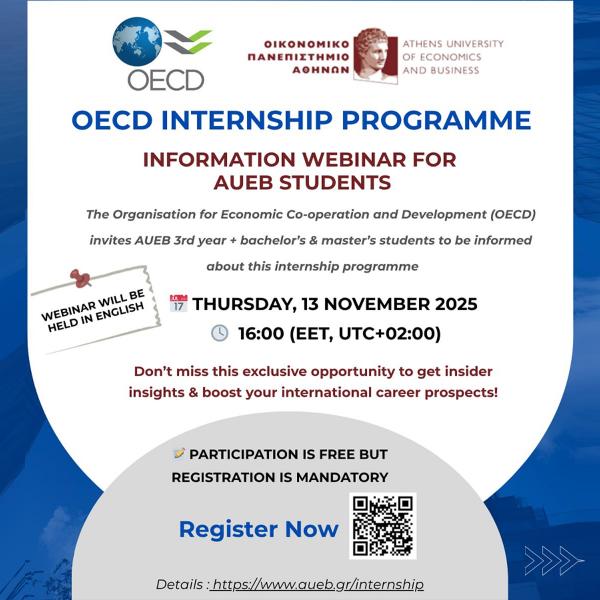
OECD Internship Programme - Webinar for AUEB students

The Internship Office of the Athens University of Economics and Business (AUEB), in collaboration with the Organisation for Economic Co-operation and Development (OECD), is organizing an informative online seminar (webinar) on the OECD Internship Programme.

The event aims to inform AUEB students about:

  • the internship opportunities offered by the OECD,
  • the application process and selection criteria,
  • the required skills and eligibility conditions,
  • the benefits of gaining professional experience in one of the most important international organizations.

For more information and to register for the event, please visit the Internship Office’s webpage: https://www.aueb.gr/internship

Athens Macroeconomics Workshop September 17th and 18th 2025

Athens Macroeconomics Workshop September 17th and 18th 2025


On 17–18 September, the Department of Economics will host an international Macroeconomics Workshop at the Athens University of Economics and Business, co-organized with Lancaster University.

The full program and event details are available [here], and registration can be completed [here] (places are limited).

The workshop will feature keynote lectures by Benjamin Born (University of Bonn) and Ricardo Nunes (University of Surrey).

This workshop is organized under the H.F.R.I. call “Basic Research Financing (Horizontal Support of All Sciences)” within the National Recovery and Resilience Plan “Greece 2.0”, funded by the European Union – NextGenerationEU.

More information about the HFRI project can be found [here].

Unesco Chair Lecture: Gold, Green, Diamond: What You Should Know About Open Access Publishing Models, by Françoise Gouzi


UNESCO Chair on Digital Methods for the Humanities and Social Sciences


Time

Friday, 09 May 2025, 4:00-6:00 p.m.

Place

Trias Building, Room T107, Trias 2 & Spetson, Athens 11362

Speaker

Françoise Gouzi

Digital Research Infrastructure for the Arts and Humanities (DARIAH-EU)

Title

Gold, Green, Diamond: What You Should Know About Open Access Publishing Models

Abstract

The Open Access (OA) movement is quite complex: it involves diverse principles, models, and policy frameworks. The goal of this presentation is to introduce learners to the origins and evolution of Open Access and provide insights into its objectives and global impact. We will progress into the following chapters and end with a Q&A interactive session:

  • the historical development of the Open Access movement;
  • key milestones and activities of specific pioneers that helped structure the movement;
  • Terminology and concepts of Open Access models

Audience: Current students and alumni of our MSc in Digital Methods for the Humanities program, who bring diverse perspectives and a keen interest in the intersection of technology and the humanities. Post graduate students who have never heard about OA and AUEB staff.

Format: 1-hour long followed by a Q&A session

Possible topics: The OA routes for beginners

Françoise Gouzi is working as Open Science Officer at DARIAH-EU. She is responsible for fostering and implementing Open Science practices across the DARIAH network. She contributes to the design and implementation of open science policy statements, guidelines and services related to the open dissemination of research results in the humanities.

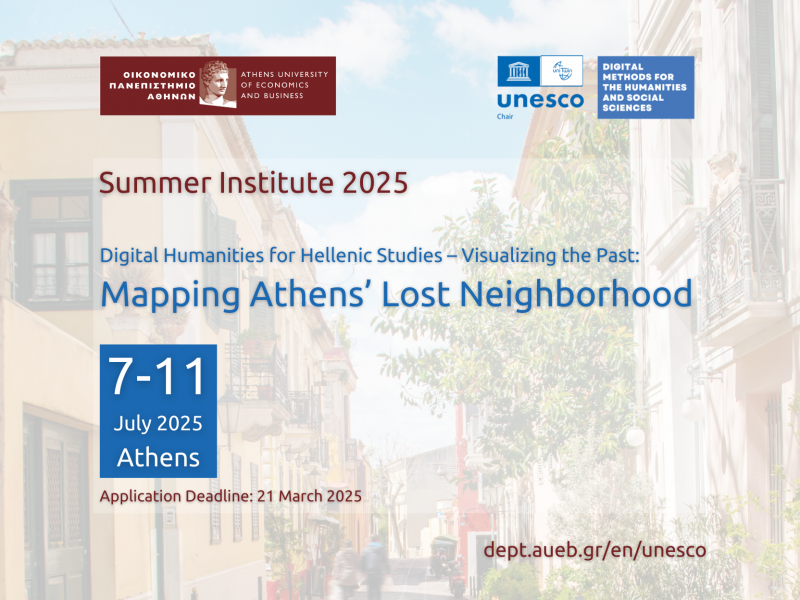
Summer Institute: Digital Humanities for Hellenic Studies – Visualizing the Past: Mapping Athens’ Lost Neighborhood, 7-11 July 2025, Athens

UNESCO Chair on Digital Methods for the Humanities and Social Sciences


Summer Institute 2025

Digital Humanities for Hellenic Studies – Visualizing the Past: Mapping Athens’ Lost Neighborhood, 7-11 July 2025, Athens


This workshop is designed for scholars interested in exploring digital humanities methods for mapping and spatial visualization. Participants will be introduced to key topics, including spatial data collection, geocoding, georeferencing, data wrangling, different types of maps, mapping and visualization platforms, and hosting. Workshop participants will work collaboratively to create a digital map of the Vrysaki neighborhood of Athens before its demolition.

This program is sponsored by the Seeger Center for Hellenic Studies at Princeton University in collaboration with the Center for Digital Humanities at Princeton; Princeton University Library; Princeton’s Department of Art and Archeology; the UNESCO Chair on Digital Methods in the Humanities and Social Sciences at AUEB; the MSc Program in Digital Methods for the Humanities at AUEB; and the Digital Research Infrastructure for the Arts and Humanities (DARIAH-EU).

Language: English

Application Deadline: 21 March 2025

More information and applications: https://hellenic.princeton.edu/opportunities/summer-institute-digital-humanities-hellenic-studies-%E2%80%93-visualizing-past-mapping


IQVIA: Career opportunities and internships in Health Economics, 18/12/24, 12:15-14:00, Eveplidon building


Presenter: George Nikolaidis, Associate Director @ IQVIA

Date: Wednesday, December 18, 2024

Time: 12:15 - 14:00

Room: 701 (Evelpidon building, Evelpidon 47A & Lefkados 33 str., 7th floor)

This lecture offers a comprehensive introduction to the field of health economics, focusing on economic evaluation and decision modelling. It covers key concepts such as cost-effectiveness analysis, the value of information, and the use of decision trees and Markov models to assess healthcare interventions. The lecture also highlights historical milestones in health economics, the importance of evidence-based medicine, and the challenges of representing uncertainty in decision-making. Additional practical material in R will be provided for anyone interested in getting hands-on experience.

No registration required


AUEB Statistical Data Science & Economics Conference, Aegina, 2024

AUEB Statistical Data Science & Economics Conference 2024

28-30 August 2024, Aegina Island

We are pleased to announce the first Statistical Data Science and Economics Conference. 

​This series of conferences will focus on the intersection of Statistical Data Science and Economics, uncovering innovative methodologies to analyze and interpret economic phenomena in the digital age. This conference provides an opportunity for experts and enthusiasts to exchange insights, bridging the gap between data-driven approaches and economic theories for impactful decision-making.

​The conference is jointly organized by the Department of Statistics, the Department of Economics and the Department of International & European Economic Studies of Athens University of Economics and Business.

More info: https://aueb-analytics.wixsite.com/statdatascience-econ 


Summer Institute: Digital Humanities for Hellenic Studies – Working with Ancient and Medieval Texts, June 25–28, 2024, Athens


UNESCO Chair

for Digital Methods in the Humanities and Social Sciences


Summer Institute: Digital Humanities for Hellenic Studies – Working with Ancient and Medieval Texts

June 25–28, 2024, Athens


Application Deadline: March 31, 2024 (11:59pm EDT).

Language: English

Information an Application: https://hellenic.princeton.edu/opportunities/summer-institute-digital-humanities-hellenic-studies-2024

Pages